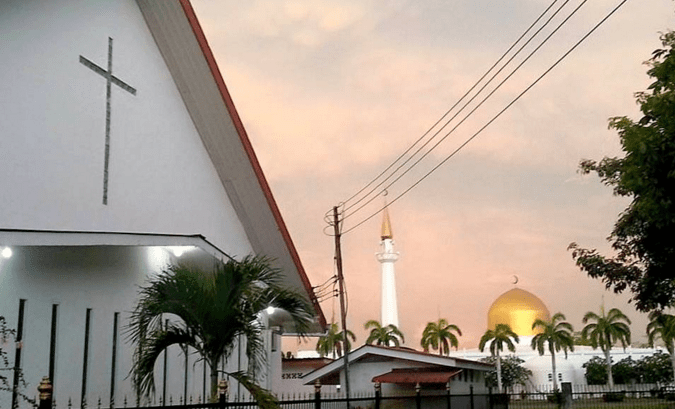
In Lutong, near Miri, a mosque and an Anglican church solve a weekly problem together. Muslims use the church's parking for Friday prayer; Christians use the mosque's parking on Sunday. It is an ordinary arrangement—and that ordinariness reveals more about coexistence than a slogan ever could.
FIRST, THE CATEGORIES
Religion is not ethnicity
- Muslim
- A religious identity shared by Malays, Banjar, Bajau, Melanau, converts and many others.
- Christian
- Includes Catholics, Anglicans, Methodists, SIB/BEM and other churches across many ethnic groups.
- Chinese
- An ethnic umbrella, not a religion; Bornean Chinese may be Buddhist, Christian, Muslim, Taoist, Confucian or non-religious.
- Dayak
- A broad Indigenous identity encompassing many peoples and languages, not a single faith.
ONE ISLAND, DIFFERENT MAJORITIES
Representation changes by region
These snapshots come from different official systems and years, so they describe each jurisdiction rather than one perfectly comparable island-wide census. Malaysia's figures are from MyCensus 2020; Brunei's from its 2021 census; Kalimantan's aggregate uses Indonesia's 2023 civil-registration data.
Sarawak
MYCENSUS 2020Christian 50.1% · Muslim 34.2% · Buddhist 12.8%. Chinese ethnicity: 23.8%; Bumiputera categories: 75.7%.
Sabah
MYCENSUS 2020Muslim 69.6% · Christian 24.7% · Buddhist 5.1%. Chinese ethnicity: 9.5%; non-citizens form a significant 23.7% of the counted population.
Brunei
CENSUS 2021Muslim 82.1% · Christian 6.7% · Buddhist 6.3% · other or none 4.9%. Ethnically, 67.4% were classified Malay and 9.6% Chinese.
Indonesian Kalimantan
CIVIL REGISTRATION 2023Muslim 78.4% · Protestant 9.30% · Catholic 9.09% · Buddhist 1.94%. The aggregate hides major provincial and district differences.
WHY PEOPLE ARE HERE
Rivers, ports, missions and migration
Islam developed through coastal trade, royal networks and the sultanates of Brunei, Banjar, Kutai, Sambas and Pontianak. Conversion often connected people to Malay court culture and commercial life, although Muslim identity never belonged to one ethnicity alone.
Christianity expanded later through Catholic and Protestant missions, especially in interior areas. Churches brought schools, literacy and health services, but conversion was not simply imposed from outside. Iban, Bidayuh, Kenyah, Kayan, Kelabit, Ngaju and other communities adopted, translated and reshaped Christianity through local kinship and adat. Anthropologist Liana Chua shows that Bidayuh Christians continue to negotiate what counts as religion, culture and ancestral practice rather than replacing one complete system with another (Chua, 2012).
Chinese connections reach back through trade, but large settlements grew through gold mining in western Borneo and colonial-era recruitment for agriculture, commerce and urban labour. Hakka, Teochew, Hokkien, Cantonese and Foochow histories differ. West Kalimantan's mining kongsi, Sarawak's Bau settlements and the Foochow migration to Sibu are not one migration story (Ting & Ling, 2026).
HOW COEXISTENCE WORKS
Not just tolerance—infrastructure
Everyday practices
- Mixed families negotiate food, ritual and holiday visits.
- Malay and Indonesian provide shared languages across difference.
- Markets, schools and workplaces create repeated contact.
- Open houses turn religious festivals into social invitations.
Supporting institutions
- Adat regulates relations within and between communities.
- Churches, mosques, temples and associations provide welfare.
- Local government mediates land, buildings and public celebrations.
- Interfaith bodies create channels before disputes escalate.
The Lutong parking arrangement is a particularly clear example because it is material: coexistence is built into gates, schedules and reciprocal obligation. In 2025, both congregations described the practice as an established local habit rather than a ceremonial performance (The Borneo Post, 2025).
Harmony is not the absence of difference. It is the presence of relationships and institutions capable of carrying difference.
WHAT A HARMONY STORY CAN HIDE
Coexistence is real, but never automatic
Anthropology cautions against portraying Borneo as naturally harmonious. Census categories harden identities that are more flexible in life. National borders divide related peoples. Conversion can alter inheritance, marriage and official ethnicity. Indigenous religions have often been compressed into “other” or administratively attached to larger recognised religions. Migration and unequal citizenship also shape who can access land, education and political representation.
The island has experienced serious communal violence, including conflicts in West and Central Kalimantan. Those histories should not be reduced to religion: migration policy, land, labour, political exclusion and ethnic stereotyping were also central. Likewise, current legal environments differ sharply among secular Indonesia, Malaysia's federal-state system and Brunei's Islamic monarchy.
The honest conclusion is neither “Borneo is perfectly harmonious” nor “religion inevitably divides.” Coexistence succeeds where people develop practical reciprocity, flexible cultural competence and trusted ways to manage disagreement.
REFERENCES
Data and interpretation
- Department of Statistics Malaysia. Sarawak MyCensus 2020 and Sabah MyCensus 2020.
- Brunei DEPS. Population by religion, 2021.
- Indonesia Ministry of Home Affairs. Civil-registration totals by religion, 31 December 2023.
- Chua, L. (2012). The Christianity of Culture. Palgrave Macmillan.
- Sintang, S., et al. (2022). The spirit of human fraternity in Sabah's inter-religious landscape.
- Ting, H., & Ling, H. (2026). Chinese migration to Sampadi, Sarawak. Journal of Borneo-Kalimantan, 12(1).
- Chua, L. (2022). Christianity, cosmopolitics, and living with difference in Sarawak. Current Anthropology, 63(6).
Researched and written by Julieta Castiñeira de Dios.