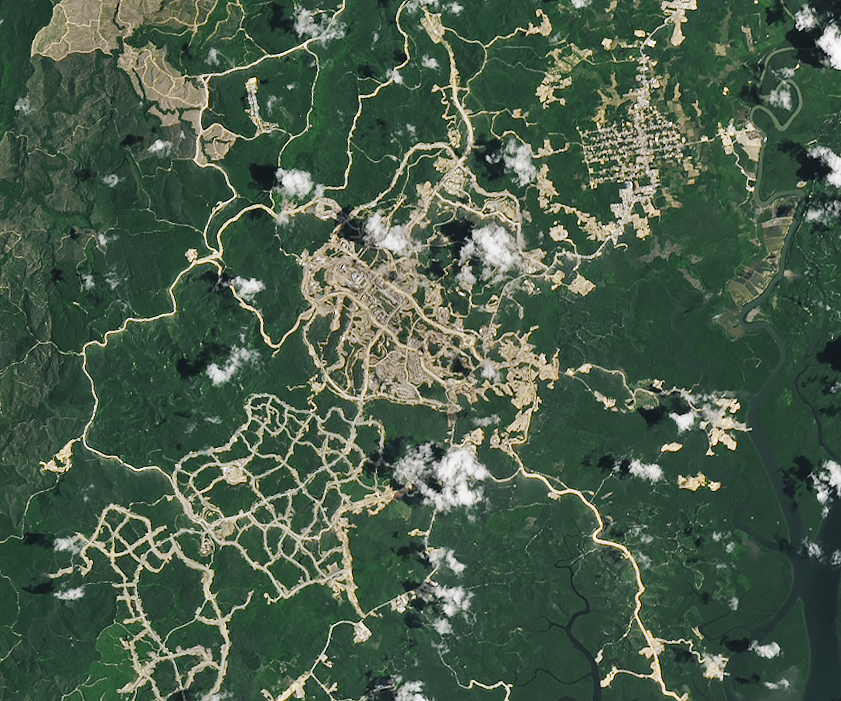
Indonesia is attempting something few countries ever try: moving the political centre of a nation of more than 280 million people from one of the world's largest urban regions to a purpose-built city on Borneo. Nusantara already has roads, government buildings and residents. Yet Jakarta is still legally the capital, most ministries have not moved, and the project's final form remains dependent on decades of finance, restoration and political commitment.
KEY FACTS
Nusantara at a glance
- Legal status
- Created by law, but not yet formally activated as Indonesia's capital by the required presidential decree.
- Location
- Between North Penajam Paser and Kutai Kartanegara, East Kalimantan—not on empty land, but within lived, worked and contested landscapes.
- Original cost estimate
- About Rp466 trillion; the early model envisaged roughly one fifth from the state budget and the balance from other sources.
- Current transfer target
- A functioning “political capital” in 2028 is the latest official milestone; the wider build-out extends to 2045.
- Who is there now
- Staff of the Nusantara Capital Authority and some institutional and service workers live or work on site. This is not yet a wholesale national civil-service relocation.
- What visitors can see
- Selected public areas and viewpoints, subject to access rules. The site remains an active construction zone.
THE OPENING QUESTION
A new political centre—or a new set of risks?
President Joko Widodo announced the East Kalimantan location in August 2019. Parliament then enacted Law No. 3 of 2022, creating the new capital and its authority. The project has since acquired a palace complex, housing towers, roads, utilities and ceremonial spaces. It also acquired a powerful national story: a chance to rebalance development away from Java and to build a technologically advanced “forest city.”
But a construction site is not the same as a functioning capital. The distinction matters because government releases often describe packages awarded, investment agreements and future capacity alongside completed buildings. This feature treats four categories separately: verified achievements, work under construction, funded or contracted commitments, and future promises.
THE GEOGRAPHY
From Java to East Kalimantan
This is a contextual locator, not a route map. Jakarta sits on Java's northwest coast; Nusantara is being developed near Balikpapan and Samarinda in East Kalimantan.
WHY LEAVE JAKARTA?
A metropolis under compounding pressure
Jakarta's difficulties are real, but they are often flattened into the misleading phrase “the city is sinking because of climate change.” The principal driver of its severe land subsidence is groundwater extraction, intensified by urban loading and the compression of sediments. Peer-reviewed work maps the relationship between groundwater use and subsidence, while more recent research also identifies soil consolidation and building loads as contributing processes (Abidin et al.; recent remote-sensing synthesis). Sea-level rise then raises the coastal baseline and compounds flood exposure; it does not by itself explain the sinking ground.
The wider urban burden includes recurrent river and coastal flooding, traffic congestion, harmful air pollution, a metropolitan population counted in the tens of millions, unequal access to piped water, overloaded waste and drainage systems, and the concentration of government and economic activity on Java. The World Bank has long linked Jakarta's subsidence primarily to intensive deep-groundwater extraction and stressed that poorer communities carry disproportionate flood risk.
WHY EAST KALIMANTAN?
Centrality, state land and lower disaster exposure
The government presented the chosen area as comparatively central within the archipelago, close to the established cities and logistics hubs of Balikpapan and Samarinda, less exposed than many Indonesian regions to major earthquakes, volcanoes and tsunamis, and containing substantial land already classified as state-controlled. Its selection also served the political goal of redistributing development beyond Java.
Those criteria do not make the site vacant. East Kalimantan is home to Indigenous peoples—including Balik, Paser and Dayak communities—settlements, farms, plantations, mining and forestry concessions, transport corridors and ecologically important forest and watershed systems. Calling the site “unused” erases overlapping customary claims, livelihoods and histories that do not always appear in formal title records.
THE ORIGINAL VISION
A smart, green “forest city”
The official master plan under Presidential Regulation No. 63 of 2022 imagines a compact, connected capital powered increasingly by renewable energy, supported by public transport and digitally managed services, with extensive green and blue networks. The Nusantara Capital Authority—the public agency managing the new capital—describes a long-term objective of restoring a landscape shaped by logging and plantations into a “forest city.”
It is an ambitious promise because the administrative boundary is not intact rainforest. Civil-society group Forest Watch Indonesia argues that remaining natural forest constitutes only a minority of the wider area and that concessions and land acquisition complicate restoration. A forest-city label therefore depends on future ecological performance—survival of planted forest, water security, habitat connectivity and emissions across the construction supply chain—not merely on landscaping around government buildings.
STATUS CHECK · 3 AUGUST 2026
What is real, and what is still promised?
Verified achievements
Core ceremonial and presidential precinct structures, sections of road and utility infrastructure, housing towers and public spaces are physically present. Nusantara Capital Authority staff and some service workers live and work on site. Public visits operate under controlled arrangements.
Under construction
The Nusantara Capital Authority reported in July 2026 that 15 of its 40 physical packages were active, while the Public Works Ministry had 12 of 90 packages still under construction. Toll-road connections, support roads and parts of the institutional district remain works in progress.
Funded or contracted
President Prabowo approved Rp48.8 trillion in state spending for 2025–2029. The authority reports signed private agreements and public-private partnership pipelines, but an agreement, tender or stated investment value is not equivalent to cash spent or a completed asset.
Future promises
A fully operational political capital, large-scale ministry relocation, mature public transport, restored forest systems and the wider 2045 city remain future outcomes. Their delivery depends on budgets, institutions, investor appetite and ecological limits.
Package counts: Nusantara Capital Authority, 15 July 2026. These are authority-reported figures and should be read as administrative progress data, not an independent construction audit.
PROMISES VS CURRENT REALITY
A capital in stages
Law establishes Nusantara, but the presidential decree that activates the transfer has not been issued. Jakarta remains the legal capital.
Some authority, health, infrastructure and institutional staff are present. Most central ministries and the broader civil service remain based in Jakarta.
Landscaping and restoration programmes have begun, but ecological success requires decades of monitoring across a heavily altered and concessioned landscape.
State budgets remain crucial. Private agreements exist, but investors have sought certainty, infrastructure and returns; headline commitments do not equal realised capital.
This is the current official milestone under Presidential Regulation No. 79 of 2025, not a guaranteed completion date for the whole city.
Some administrative pressure may shift east. Jakarta's water, subsidence, flooding, transport, air-quality and housing problems still require direct solutions.
WHO HAS MOVED?
People on site, but not a wholesale transfer
The Nusantara Capital Authority reported that 1,170 of its employees had taken up residence in civil-servant housing by July 2025, alongside smaller groups connected to a hospital and national institutions. In January 2026 it again assembled more than 1,100 authority staff in Nusantara. These numbers demonstrate an operational workforce; they do not demonstrate that Indonesia's ministries have transferred en masse.
As late as March 2026, the Ministry of Administrative and Bureaucratic Reform was still coordinating which civil servants could move during 2026 based on office and housing readiness. The latest defensible description is therefore: Nusantara is inhabited and administratively active, but Indonesia's central government has not completed its relocation.
THE LEGAL SWITCH
When does Nusantara actually become the capital?
Article 39 of Law No. 3 of 2022 makes the transfer effective through a presidential decree. The 2023 amendment, Law No. 21 of 2023, expanded the authority's land, planning and financing framework but did not eliminate that trigger. In May 2026, Indonesia's Constitutional Court and parliamentary commentary again treated Jakarta as the capital until the decree is issued (DPR media summary).
The most recent practical target is 2028, when the government wants Nusantara to function as a “political capital” with executive, legislative and judicial institutions. It is a milestone inside a development plan extending to 2045—not proof that the entire city, population target or forest restoration will be complete by then.
MONEY AND MOMENTUM
Rp466 trillion—and the difficulty behind the headline
The original national planning estimate was roughly Rp466 trillion, often reported as about US$32 billion at the exchange rates of the period. Early plans capped the central-government share at around one fifth and expected state-owned enterprises, public-private partnerships and private capital to finance most of the remainder. The legal framework now permits state-budget, authority-budget and other lawful funding sources.
President Prabowo's government approved Rp48.8 trillion in central spending for 2025–2029 (Nusantara Capital Authority; Reuters). Yet a 2025 budget freeze and subsequent adjustments exposed the project's sensitivity to national fiscal priorities. Private-investment headlines require particular care: letters of intent, memoranda, groundbreaking ceremonies, concession proposals and completed private buildings are different stages of commitment.
Supporters argue that public infrastructure must come first to de-risk later investment. Critics respond that this leaves taxpayers carrying the early risk while commercially attractive land and services may capture later value. Both observations can be true.
BORNEO IS NOT EMPTY
Land rights, consultation and livelihoods
Customary territories, villages and resource-based livelihoods intersect with formal state land and private concessions. Academic studies identify recurring risks: claims that are poorly documented in the state system, consultation compressed by fast project timelines, compensation that does not capture cultural or spiritual value, and uncertainty about access to farms, forests, rivers and burial grounds (Journal of Government Science; Indigenous participation study).
Government agencies describe mapping, compensation and community-engagement processes. Civil-society organisations including WALHI and local coalitions report residents who feel pressured, insufficiently consulted or insecure about land. These are not interchangeable claims: each dispute requires parcel-level evidence, meaningful consent processes and accessible remedies. The existence of compensation does not by itself establish that consultation was fair.
ENVIRONMENTAL TEST
Can building a city restore a landscape?
Nusantara sits within Borneo's globally important ecological region, near habitats used by threatened species and watersheds already affected by extraction and land conversion. Construction brings direct clearing, quarrying, roads, noise, sediment, material demand and carbon emissions. A larger population adds water, food, energy and waste pressures. The risk is not limited to the core zone: easier access can drive secondary development beyond it.
The government's counterargument is that the chosen landscape was already degraded and that strong planning can rehabilitate it, concentrate growth and avoid the uncontrolled expansion seen elsewhere. Whether that happens should be judged through transparent indicators: native-forest cover and survival, wildlife connectivity, water balance through dry seasons, lifecycle emissions, waste treatment and limits on speculative sprawl. A ceremonial tree-planting count is not enough.
Water availability deserves particular scrutiny. Official plans rely on reservoirs, raw-water systems and catchment protection. Visitors may see new water infrastructure, but long-term security depends on rainfall variability, competing demand and protecting upstream ecosystems—not solely on installed capacity.
INEQUALITY AND LABOUR
Who builds the city, and who benefits?
A capital can create jobs, markets, roads, education and health services. It can also raise land prices, privilege connected investors and produce a polished administrative enclave beside communities with weaker tenure and services. Construction workers face familiar Indonesian-sector risks around subcontracting, accommodation, wages and occupational safety; public reporting is not yet sufficient for a complete project-wide assessment. Where evidence is absent, claims of either exemplary or abusive conditions should not be invented.
The distributional questions are concrete: Will local people qualify for skilled permanent work? Will public housing remain affordable? Will traditional livelihoods retain access to land and water? Will services extend beyond the core government district? And will affected communities have power over decisions, not merely invitations to information sessions?
THE BEST ARGUMENTS
Supporters and critics are asking different questions
The case for Nusantara
- Indonesia needs a political geography less concentrated on Java.
- A planned city can embed public transport, efficient infrastructure and restoration from the outset.
- East Kalimantan may gain national institutions, services, jobs and connectivity.
- Moving administrative functions can reduce some pressure and risk concentration in Jakarta.
- Stopping mid-build could strand large public investments already made.
The case against—or for radical caution
- The project can reproduce extraction and inequality under a green label.
- Customary land rights and local consent may be subordinated to national urgency.
- Private finance may not arrive at the expected scale, increasing fiscal exposure.
- A new capital does not solve Jakarta's underlying urban systems.
- Political targets can reward visible monuments over slow ecological and social outcomes.
WHAT OTHER CAPITALS TEACH
Brasília and Putrajaya are warnings as well as models
Brasília proved that a state can move its political institutions and use modernist planning to project a national future. It also became associated with car dependence and a sharp separation between the monumental centre and peripheral workers' cities. Putrajaya demonstrates a different model: an administrative centre operating alongside Kuala Lumpur, with transfer occurring institution by institution rather than erasing the older metropolis.
Nusantara is not destined to repeat either. The comparisons simply show that relocating buildings is easier than producing an inclusive, lived city—and that former capitals remain economically and socially central long after government offices move.
VISITING NUSANTARA NOW
A construction landscape with controlled public access
Visitors can currently access selected public areas under the authority's rules, including ceremonial spaces and viewpoints associated with the core government district. The official visitor system has included Plaza Seremoni, the Titik Nol area and designated nature or public-space experiences. Access, parking, shuttle arrangements and opening windows can change around construction and state events.
Check the official Nusantara visitor guide and current notices. Do not enter active works or assume government buildings are open. Balikpapan is the usual regional gateway; road journeys vary with traffic and construction. Bring sun and rain protection, follow photography restrictions, and treat nearby settlements as communities rather than attractions.
TIMELINE
From announcement to the next milestone
- Location announced
President Joko Widodo selects East Kalimantan after reviving the long-discussed capital move.
- Capital law enacted
Law No. 3 of 2022 creates Nusantara and its dedicated governing agency, the Nusantara Capital Authority.
- First construction phase
Land preparation, roads, utilities, palace precinct and housing advance; opening targets are repeatedly compressed.
- Law amended
Law No. 21 of 2023 expands land, authority, planning and financing provisions.
- Independence ceremony
A national ceremony is held at Nusantara, but the formal capital transfer and mass civil-service move do not occur.
- Budget and target reset
Funding is frozen and adjusted before the government confirms a Rp48.8 trillion 2025–2029 allocation; a 2028 political-capital target emerges.
- Construction and partial occupation
Authority staff work on site; ministries coordinate later transfers; major packages and access links remain under construction.
- Political capital
Executive, legislative and judicial functions are intended to operate in Nusantara. This remains a target, not a completed fact.
- Long build-out
The master plan's mature city and restoration outcomes extend to Indonesia's centenary.
CONCLUSION
A project large enough to hold opposing truths
Nusantara is neither an imaginary city nor a finished capital. It is a substantial, inhabited construction project backed by law and public money, with real infrastructure and a long list of unfinished dependencies. It could redistribute state attention, demonstrate better urban systems and channel restoration into a damaged landscape. It could also deepen land conflict, fiscal risk and ecological pressure while leaving Jakarta's hardest problems intact.
The fairest test is not whether Nusantara looks futuristic from a drone. It is whether institutions genuinely move, services work beyond the ceremonial core, finance remains accountable, workers and local communities benefit, customary rights are resolved justly, and the promised forest performs as an ecosystem. Jakarta and Borneo both deserve policy grounded in those outcomes rather than in slogans.
REFERENCES
Selected sources
Links were checked on 3 August 2026. Official project sources are used for legal texts, targets and administrative progress; independent and academic sources are used to test and contextualise those claims.
- Republic of Indonesia. (2022). Law No. 3 of 2022 concerning the National Capital.
- Republic of Indonesia. (2023). Law No. 21 of 2023 amending Law No. 3 of 2022.
- Republic of Indonesia. (2022). Presidential Regulation No. 63 of 2022: Nusantara Capital Master Plan.
- Nusantara Capital Authority. (2026, July 15). Phase II development progress and package evaluation.
- Nusantara Capital Authority. (2025, July 30). Phase II and civil servants residing in Nusantara.
- Ministry of Administrative and Bureaucratic Reform. (2026, March 10). Meeting on civil-service relocation progress.
- World Bank. (2016, January 8). Keeping Indonesia's capital safer from floods.
- Abidin, H. Z., et al. Mapping land subsidence induced by groundwater extraction in urban areas of Indonesia.
- Forest Watch Indonesia. (2024). Land acquisition in the Nusantara Capital City.
- WALHI. (2024). Civil-society and affected-resident statement on the Nusantara capital project.
- Reuters. (2025). Indonesia's president to spend about US$3 billion on the new capital through 2029.
- Associated Press. (2024). Environmental and Indigenous concerns surrounding Nusantara.
- DPR Parliamentary News. (2026, May 25). Jakarta remains capital pending a presidential decree.
- NASA Earth Observatory. (2024). Nusantara: A new capital city in the forest.
Researched and written by Julieta Castiñeira de Dios.