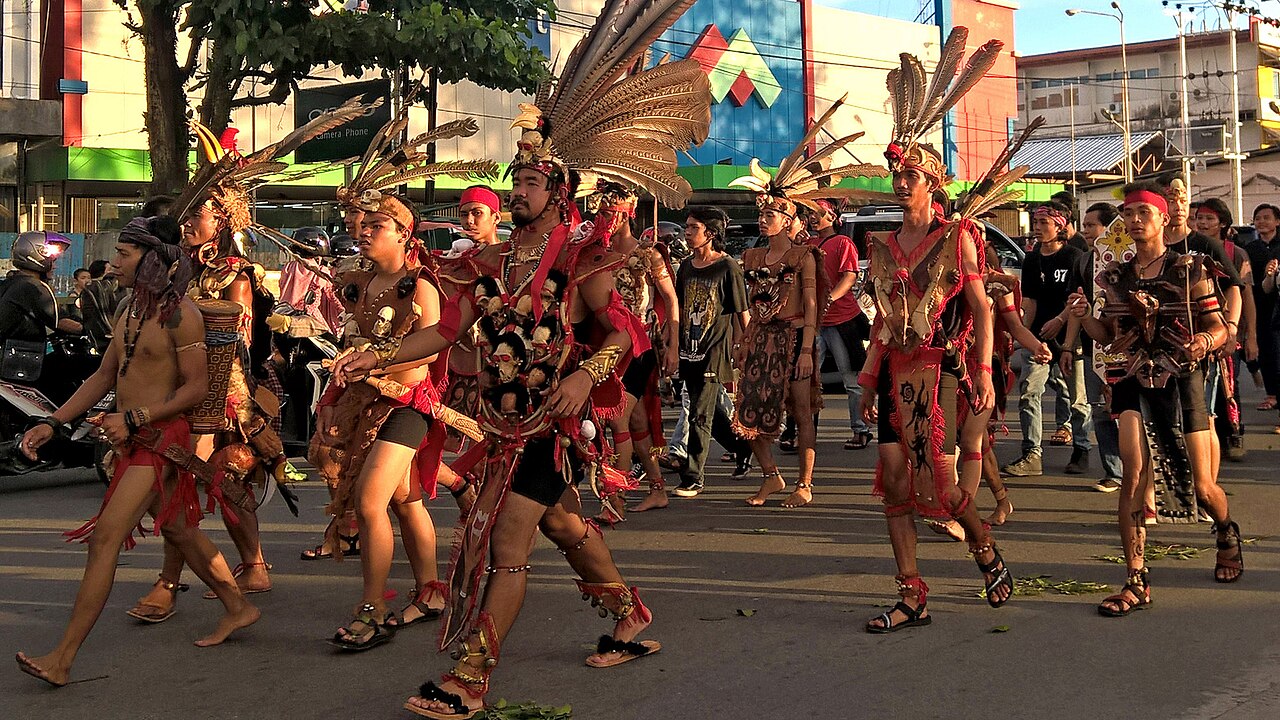
Ask how many Dayak groups exist and the honest answer is: it depends on who is counting, where a boundary is drawn and whether identity, language, ancestry or administration is being measured. “Dayak” names a relationship among peoples; it does not erase their differences.
THE ESSENTIAL CORRECTION
Dayak is plural
- Not one tribe
- The term covers many Indigenous peoples of Borneo, especially communities historically associated with the interior and river systems.
- No agreed total
- Frequently repeated estimates reach about 450 ethnolinguistic groups, but counting changes with classification.
- No single language
- Dayak languages belong to several branches of the Austronesian family and are often not mutually intelligible.
- No single religion
- Dayak people may be Christian, Muslim, Hindu/Kaharingan, Buddhist or practitioners of ancestral traditions.
- No single lifestyle
- Dayak people live in longhouses, villages, towns and global cities, working in every modern profession.
- A modern identity
- The umbrella can support political solidarity and Indigenous rights while people retain specific identities such as Iban or Kenyah.
A NAME THAT CHANGED
From outsider label to collective identity
European administrators and writers used variants such as Dyak to classify diverse non-Muslim Indigenous communities, often contrasting an upriver “Dayak” with a coastal “Malay.” That division was never absolute: people moved along rivers, married, traded, converted and changed political affiliation.
Today many communities claim Dayak positively as a shared Indigenous and political identity, particularly in Indonesian Kalimantan. Usage differs in Malaysia: Iban and Bidayuh may be grouped historically under “Sea Dayak” and “Land Dayak,” but official and everyday identities usually prefer their own names. Sabah's Kadazandusun and Murut peoples share parts of this wider Bornean history but are not universally described as Dayak.
A SMALL ATLAS
Some major peoples and clusters
This selection is illustrative, not a hierarchy or complete list. Names may refer to ethnic identities, language clusters or regional alliances, and classifications differ across borders.
Iban
Sarawak, West Kalimantan and Brunei; historically riverine, with a major literary and media language.
Bidayuh
Southwestern Sarawak and neighbouring West Kalimantan; internally diverse Land Dayak languages.
Kayan & Kenyah
Related but distinct upriver peoples across central and northern Borneo, with multiple languages and long migration histories.
Ngaju & Ot Danum
Central Kalimantan peoples associated with Barito-region languages and important Kaharingan traditions.
Kanayatn
A major West Kalimantan identity whose languages sit within the Malayic linguistic branch.
Maanyan
Southeastern Borneo; their language is famously related to Malagasy, although Madagascar's settlement involved wider maritime networks.
Kelabit & Lun Bawang
Highland and borderland peoples of Sarawak, Sabah, Brunei and North Kalimantan.
Penan & Punan
Names used for several distinct communities; some have histories of mobile forest life, but the terms are not interchangeable.
Tamanic, Maloh and others
Examples of smaller clusters whose linguistic relationships show why geography alone cannot classify Dayak peoples.
LANGUAGES, NOT DIALECTS
Borneo is a linguistic crossroads
It is misleading to speak of “the Dayak dialect.” Most Indigenous languages of Borneo are Austronesian, but they fall across multiple branches. Iban and Kanayatn varieties are Malayic; Bidayuh languages form Land Dayak groupings; Maanyan belongs to the Barito linkage; Tamanic languages show a close relationship with South Sulawesi; and northern Borneo languages connect with wider Philippine-type patterns.
Two neighbouring communities may speak languages that are not mutually intelligible, while peoples separated by distance may share an older linguistic relationship. Multilingualism is therefore normal: a person may use a home language, a regional language, Malay or Indonesian, and English. The urgent issue is transmission. Schooling, migration and digital life strengthen national languages while some small community languages lose young speakers (Smith, 2024).
“Dayak” is a social and political umbrella. It is not a branch on a language-family tree.
WHAT CONNECTS—WITHOUT MAKING EVERYONE THE SAME
Adat, rivers and relational life
Across many communities, adat describes inherited law, ethical practice and the proper conduct of relations among people, ancestors, land and non-human beings. Longhouses have often organised households into a shared social architecture, while river networks connected farming, forest products, ritual exchange and migration.
These are family resemblances, not universal traits. Swidden rice cultivation can be ecologically knowledgeable and carefully regulated, but not every Dayak person farms. Longhouses can be living communities, ceremonial centres or heritage forms, but not every group traditionally used them in the same way. Hornbills, beadwork, tattoos and woven textiles carry specific meanings that should not be detached from their makers and turned into one generic “tribal aesthetic.”
RELIGION AND CONTINUITY
Conversion did not erase culture
Christian missions expanded in many interior regions through schools, literacy, medicine and evangelisation. Communities actively interpreted the new religion, sometimes abandoning rituals, sometimes reframing them as culture, and sometimes maintaining relationships with ancestors and customary law alongside church life. Liana Chua's Bidayuh ethnography shows that “religion” and “culture” are continuously negotiated categories, not clean historical layers (Chua, 2012).
In Central Kalimantan, Kaharingan gained administrative recognition through association with Hinduism, while recent Indonesian policy has opened limited space for aliran kepercayaan. Muslim Dayak identities also have long histories. Religious affiliation does not provide a reliable test of whether someone is “really” Dayak.
MYTHS AND MISCONCEPTIONS
What the stereotype leaves out
It is an umbrella for numerous self-identifying peoples, with boundaries that vary by country and institution.
There is no single Dayak language. Bornean languages belong to several distinct Austronesian groupings.
Some communities practised head-taking historically in specific ritual and political contexts; many did not, and the practice does not define contemporary life.
Dayak histories include farming, trade, warfare, towns, education, wage labour and international migration.
Conversion transformed communities, but adat, kinship and ancestral relations were variously retained, debated or reclassified.
Ceremonial clothing is living heritage, not a costume that represents what everyone wears daily.
THE HEADHUNTER IMAGE
A colonial frame that became a brand
Head-taking was historically practised by some Bornean societies and could relate to warfare, mourning, fertility, prestige, defence or revenge. It caused real harm. But nineteenth-century travel writing selected the most dramatic practice and turned it into the defining essence of millions of people.
Colonial governments then presented suppression as proof of civilisation, even while using military violence themselves. The 1894 Tumbang Anoi meeting is often remembered as a major intercommunity agreement to end warfare and headhunting, although historical change was gradual and involved Indigenous diplomacy as well as colonial power. Modern tourism and media sometimes reproduce the old image because it sells an easily recognisable “wild Borneo.”
A better question is not whether the stereotype contains a fragment of history. It is why that fragment was chosen to represent everyone, while law, poetry, ecological knowledge, diplomacy and contemporary creativity were ignored (Putra, 2011).
DAYAK MODERNITIES
Indigenous does not mean frozen in time
Dayak leaders, artists, scholars, church workers, civil servants and activists have reshaped the umbrella identity through organisations, festivals and political movements. Gawai Dayak in West Kalimantan and Sarawak's Gawai Dayak make culture publicly visible, but staged celebration is only one part of life.
Current struggles include customary land recognition, plantation and dam development, forest governance, language transmission, urban belonging and the ownership of cultural designs. These are not battles between “tradition” and “modernity.” They are debates about who has the authority to decide what development and cultural continuity should mean.
REFERENCES
Selected foundations
- Smith, A. D. (2024). Historical linguistics of Borneo. Oxford University Press.
- Adelaar, K. A. Borneo as a crossroads for comparative Austronesian linguistics. ANU Press.
- Chua, L. (2012). The Christianity of Culture. Palgrave Macmillan.
- King, V. T. (1993). The Peoples of Borneo. Blackwell.
- Rousseau, J. (1990). Central Borneo: Ethnic Identity and Social Life in a Stratified Society. Oxford University Press.
- Putra, R. M. S. (2011). Makna di balik teks Dayak sebagai etnis headhunter.
- BPS-Statistics Indonesia. (2012). Ethnicity and language from the 2010 census.
- British Museum. Dayak collection term and scope note.
Researched and written by Julieta Castiñeira de Dios.