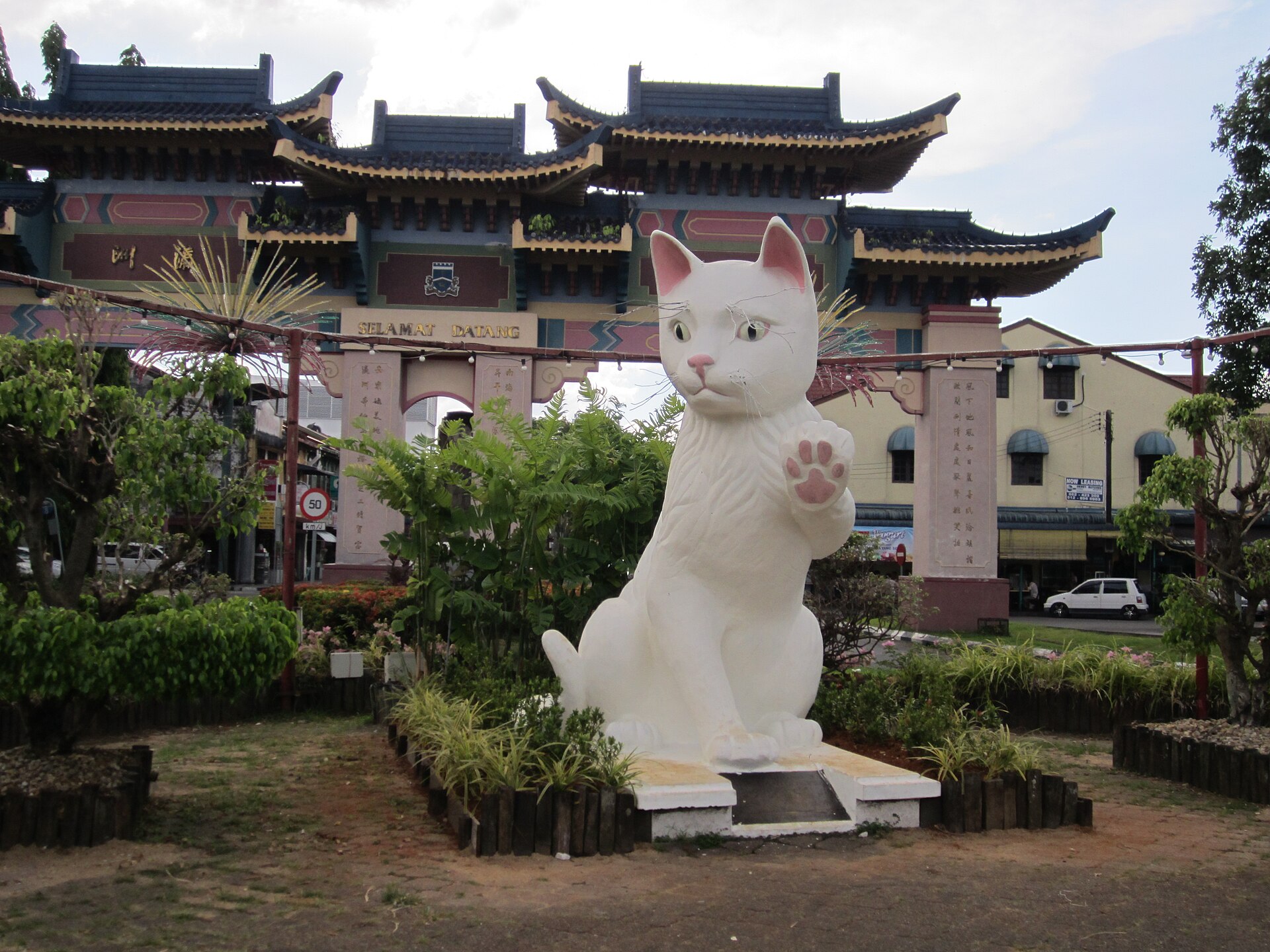
Walk through Kuching and cats appear everywhere: waving from roundabouts, gathered in sculpted families and filling an entire museum. It feels ancient. In reality, the story is a delightful mixture of uncertain history and a modern city choosing its own symbol.
THE SHORT ANSWER
Cat City in four clues
- The name
- Kucing means cat in Malay, but the true origin of the city's name remains uncertain.
- The legends
- Stories connect it with a passing cat, wild cats, Sungai Kuching and the mata kucing fruit.
- The identity
- Public sculptures turned the wordplay into an affectionate civic symbol.
- The museum
- Kuching North City Hall manages the world's first museum devoted to cats, with more than 4,000 objects.
A NAME WITH MANY STORIES
Did a passing cat name Kuching?
The most repeated legend begins with James Brooke asking the name of the place in 1839. A local guide supposedly thought he was pointing at a cat and answered kucing. It is a wonderful story, but there is no firm evidence that this exchange named the city.
Kuching's official divisional history offers other possibilities: a small waterway called Sungai Kuching, wild cats that visited it, or nearby mata kucing fruit trees. What history can establish is that the name was already in use when Brooke arrived. The mystery is part of the city's charm, but it should be presented as a mystery (Kuching Division Administration).
WHEN A PUN BECOMES A PLACE
The city adopted the cat
Kuching did not need a single origin story to enjoy the connection. Cat statues appeared across the city, including the welcoming white cat at Padungan and the cat family on Jalan Tunku Abdul Rahman. They became landmarks, meeting points and a playful way to recognise the city in photographs.
The statues also participate in Kuching's multicultural calendar. In 2026 the Padungan cat was dressed and illuminated for Chinese New Year and Aidilfitri. Local authorities described the changing costumes as a celebration of Sarawak's shared civic life (UKAS, Chinese New Year 2026; Sarawak ministry, Aidilfitri 2026).
The cat succeeds because it is light-hearted and adaptable: one familiar figure can welcome many communities and many celebrations.
THE WORLD'S FIRST
A museum devoted entirely to cats
The Cat Museum grew from a collection first displayed in 1988 and moved into Kuching North City Hall in 1992. Today its four galleries hold more than 4,000 objects—from art and advertising to stories about domestic cats and Borneo's wild felines. It is eccentric, proudly local and completely sincere (Kuching North City Hall).
THE REAL CATS
Behind the cheerful symbol
There is no reliable evidence that Kuching has more cats per person than other Malaysian cities. The feeling comes partly from the name, monuments and souvenirs. Yet many real cats do live around its markets, suburbs and kampungs.
In March 2026, the local rescue group Pawsitive Vibes told The Borneo Post that abandonment, illness and uncontrolled breeding were creating a growing welfare challenge. Their preferred response is practical and cooperative: sterilisation, treatment, responsible adoption and community support (The Borneo Post, 17 March 2026).
A responsible visitor can
- Support established local rescue groups.
- Ask before feeding animals near homes or businesses.
- Choose adoption and sterilisation initiatives over impulse purchases.
- Seek medical advice after any bite or scratch.
A visitor should avoid
- Moving kittens without checking whether their mother is nearby.
- Feeding in ways that leave waste or attract animals to traffic.
- Treating a street animal as a photograph rather than a living creature.
- Assuming every roaming cat is homeless.
WHY THE STORY MATTERS
A city can grow into its name
Kuching may not have been named by a cat, and it may not contain more cats than everywhere else. But the city took an accidental resemblance and made it meaningful. The statues now celebrate festivals; the museum preserves an unusual collection; and animal-welfare groups ask what being the Cat City should mean for living cats.
Perhaps that is the best answer. Kuching is full of cats because generations of people decided that the cat could represent something welcoming, humorous and shared—and because the symbol now carries a small responsibility to care for the animals behind it.
SOURCES
Where the story comes from
- Kuching Division Administration. History of Kuching and possible origins of the name.
- Kuching North City Hall. Official Cat Museum history and visitor information.
- Sarawak Tourism Board. Welcome to Kuching, the Cat City.
- UKAS and the Sarawak Ministry of Public Health, Housing and Local Government. 2026 reports on the Padungan cat's festive decorations.
- The Borneo Post. (2026, March 17). Community help sought for Kuching's stray-cat population.
Researched and written by Julieta Castiñeira de Dios.